
Choosing the right hair transplant method isn’t just a medical decision—it directly affects your density, graft survival rate, and long-term aesthetic results. With Turkey leading the global market in hair restoration, most patients are torn between two advanced techniques: FUE and DHI.
In this guide, you’ll learn exactly how the tools, techniques, costs, and results differ, so you can confidently choose the method that suits your goals.
Understanding the Techniques: How FUE and DHI Differ in Implantation
The Foundation: Standard Follicular Unit Extraction (FUE)
FUE is one of the most widely used hair transplant techniques today. Its implantation process generally follows two distinct steps:
Channel (incision) creation: Tiny slits are made in the recipient area at specific angles and directions.
Graft placement: Extracted grafts are manually implanted into these pre-made channels.
Key features of FUE implantation:
Requires precision in channel direction and depth
Allows implantation of a high number of grafts
Ideal for covering large areas of baldness
The Evolution: Direct Hair Implantation (DHI)
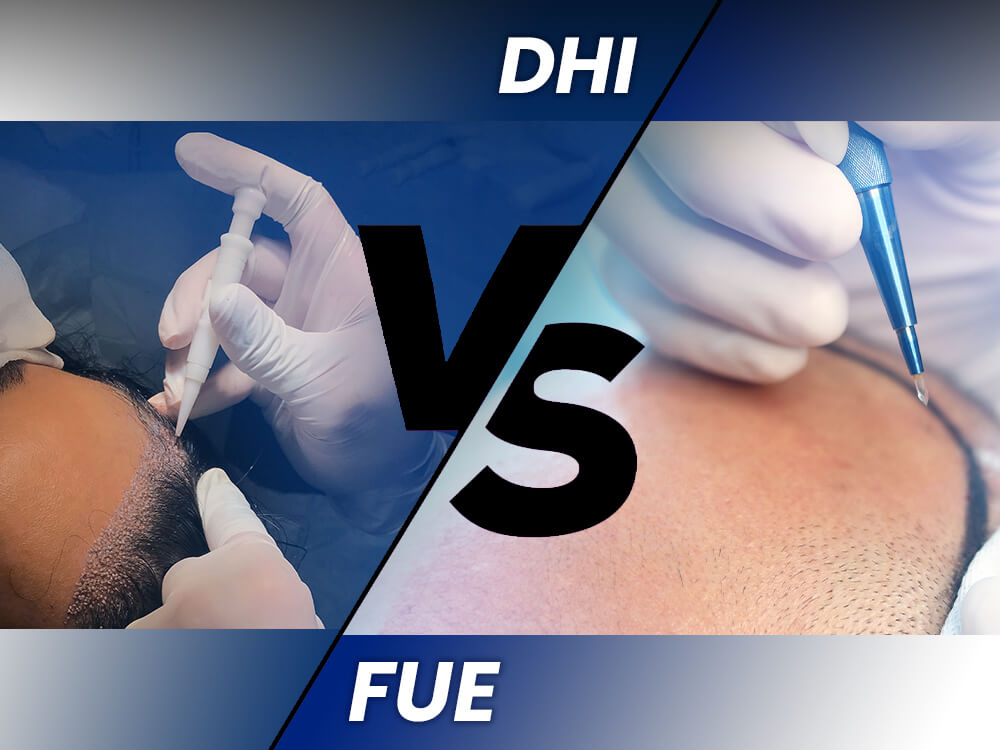
DHI is considered an advanced form of FUE, distinguished by its single-step implantation using the specialised Choi Implanter Pen.
In DHI:
The Choi pen creates the channel and places the follicle simultaneously
Each graft is loaded into the pen and implanted directly
What makes DHI unique:
More precise control over the angle, depth, and direction
Less manipulation of grafts
Shorter time grafts spend outside the scalp
Read Also:
FUE vs FUT Hair Transplant: Which Technique Delivers Better Results, Scars, and Density
Head-to-Head Comparison: Graft Survival, Density, and Precision
Graft Survival Rate and Viability
Because DHI implants grafts immediately after loading them into the Choi pen, the follicles spend less time outside the body, which may improve graft viability.
DHI: Higher survival potential in many cases
FUE: Excellent survival, but dependent on surgeon skill and handling time
Density and Angle Control
DHI offers superior precision due to the controlled mechanics of the Choi Pen:
360-degree angle control
Ability to place grafts closer together
Enhanced natural-looking density, especially at the hairline
FUE, while effective, typically allows slightly less density in highly detailed areas like the front hairline.
Suitability for Unshaven Procedures
DHI is often the preferred method for:
Unshaven (U-FUE) transplants
Small touch-ups or corrections
Temple peaks, hairline refinement, and eyebrow restoration
FUE usually requires shaving the donor area and is better suited for large-scale coverage.
Practical Considerations for Turkish Medical Tourism
Cost and Procedure Duration in Turkey
Turkey offers some of the world’s most competitive hair transplant pricing. However:
DHI is typically more expensive due to specialized tools, more staff involvement, and a longer implantation process.
FUE is usually more cost-efficient and faster for large sessions.
Ideal Candidacy: When to Choose DHI Over FUE
You should consider DHI if your goals include:
High hairline density
Maximum angle control
Minimal shaving
Detail-oriented work
You should consider FUE if you need:
Maximum graft numbers
Broad coverage
Shorter procedure time
A more budget-friendly option
Frequently Asked Questions (FAQs)
Q1: Is DHI a type of FUE?
Yes. Both use FUE extraction. The difference is in the implantation method, not the harvesting.
Q2: Does DHI have better results than FUE?
For density and precision, yes—especially at the hairline.
For large-area coverage, FUE may deliver better efficiency.
Q3: Is DHI suitable for a large area of baldness?
Not typically. DHI is slower and more labor-intensive, making FUE the better option for high graft counts.
Q4: How long does DHI recovery take compared to FUE?
Recovery times are similar, but DHI may show slightly less trauma to the recipient area thanks to smaller incisions.
Securing Your Dream Hairline with Confidence
When choosing between FUE and DHI, the decision ultimately depends on your goals, donor capacity, and desired precision:
FUE: Best for efficiency, large coverage, and budget-friendly results
DHI: Best for maximum density, angle control, and natural-looking hairlines
For a personalized evaluation of which method is ideal for your hair type and restoration goals, contact aestheticairways today and take the first step toward achieving your dream hairline with confidence.